ChatGPT Isn't a Strategy
Cade Cunningham
Author
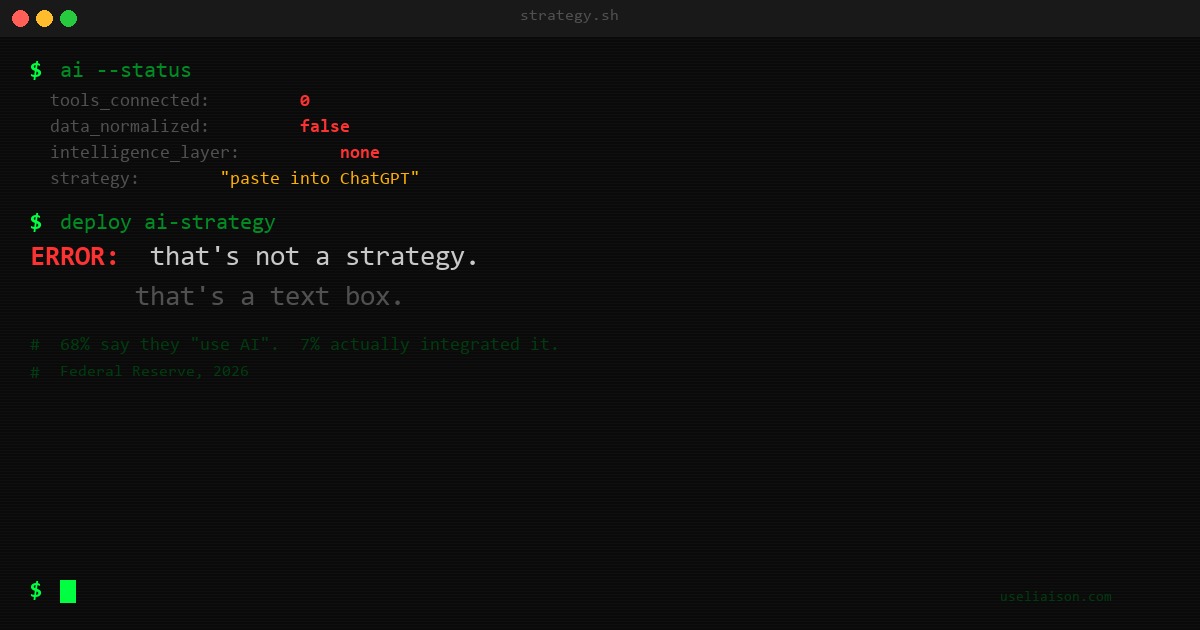
So here's the stat that nobody wants to talk about. 68% of businesses say they're "using AI" right now. That sounds great until you look at what "using AI" actually means. According to the Federal Reserve's 2026 Small Business Credit Survey, only 7% of those businesses have AI fully integrated into their operations. 50% are still just "experimenting." 44% are partially there.
And what are they experimenting with? Marketing copy and customer service chatbots. 36% use AI for marketing. 36% for customer service. Finance? 16%. Inventory? 11%. HR? 6%.
That's not AI adoption. That's using a fancy text box.
The gap nobody's measuring
There's a difference between using AI and running your business on AI. Most owners I talk to, when they say "we use AI," they mean someone on their team has a ChatGPT login. They paste in a document, ask it to rewrite something, maybe get it to draft an email. Cool. That's a productivity hack. It's not a strategy.
A strategy is when your CRM data feeds into your accounting system which informs your scheduling which connects to your capacity planning, and AI sits on top of all of it, watching patterns you'd never catch yourself. That's when you get the insight that says your Tuesday crew generates 40% more upsells than your Thursday crew. Or that you're going to have a cash flow gap in six weeks because your invoicing backlog is quietly growing.
ChatGPT can't tell you that. It doesn't know your business exists.
The back office is wide open
Look at where businesses are actually applying AI and you see the problem clearly. Marketing and customer service get all the attention because they're easy. You paste text in, you get text out. But the operational core of the business, the stuff that actually determines whether you make money, is barely touched.
Bookipi surveyed 2,121 business owners across 17 industries and found the number one barrier to AI workflow adoption isn't cost. It's complexity. 31% said lack of expertise. 23% said unclear ROI. People want this, they just don't know how to make it work past the chat interface.
And that's where the real opportunity is. Deloitte's 2026 State of AI report found that 74% of companies want AI to grow their revenue, but only 20% have actually seen revenue impact. That's because they're applying AI to the easy stuff (rewriting emails) and ignoring the hard stuff (connecting their actual business data).
What operational AI actually looks like
So what does it look like when a business actually wires AI into their operations instead of just using it as a search bar with better grammar?
It looks like this: a 15-person HVAC company connects their scheduling tool, QuickBooks, their CRM, and their review platform to one intelligence layer. Now instead of checking four apps every morning, the owner opens one dashboard that tells them their revenue is tracking 8% below last month, two technicians are consistently running behind on callbacks, and three customers are showing churn signals based on communication frequency drops.
None of those individual tools can see that picture. QuickBooks knows the revenue. The CRM knows the customer communication. The scheduling tool knows the technician performance. But until they're connected with intelligence on top, you're flying blind and calling it "using AI."
The ECI AI Readiness Report that came out on March 11 surveyed 550 business leaders and found that manufacturing and field service companies feel the most urgency here. They're the ones dealing with labor shortages and operational complexity every day. They can't solve their problems with a chat interface.
The uncomfortable math
The SBE Council published new data on March 11 showing businesses that actually use AI tools (not just chat with them) save an average of 16.5 hours per week. The median spend? $2,200 per year.
So for less than $200 a month, businesses are getting back two full workdays per week. But only if the AI is connected to their operations. If you're just using ChatGPT, you're saving maybe 20 minutes a day on email drafts. That's the difference between a shortcut and a strategy.
93% of businesses plan to maintain or increase their AI spending this year. 40% have nothing to show for what they've already spent. Both of those stats came out the same day. That's a $2,200-per-year budget being lit on fire because nobody showed these owners what AI looks like past the text box.
Our job is to close that gap. Not by selling another tool, but by connecting the tools they already have and putting intelligence on top. Keep your CRM. Keep QuickBooks. Keep your scheduling app. Just stop pretending that a ChatGPT subscription means you've adopted AI.
Because you haven't. Not yet.
Share this article
Related Articles

The Efficiency Is in Your Role, Not Your Vertical
So Avoca is booking a billion dollars of trade jobs over the phone, and that's real. But it's built for one function in one industry, and your job as the owner is every function at once. That's where the efficiency actually is, and nobody was building for it.

Instinct, Town and Grok Bot Are All Task Assistants. Liaison Is the Digital Version of You.
So 20VC is calling it the $100 billion race between Town, Instinct and Grok Bot, and they are all doing one job. None of them builds a context layer over your business, they rent your inbox. And Grok Bot can only ever be Grok, which is a real problem if what you are selling is an outcome.

The Interface Is Your Phone
This week we turned on something I've wanted since the beginning: you can tell Liaison to text you. It isn't a feature, it's a position on where an owner actually is, which is not in front of a screen.