The SaaSpocalypse Isn't About Killing SaaS
Cade Cunningham
Author
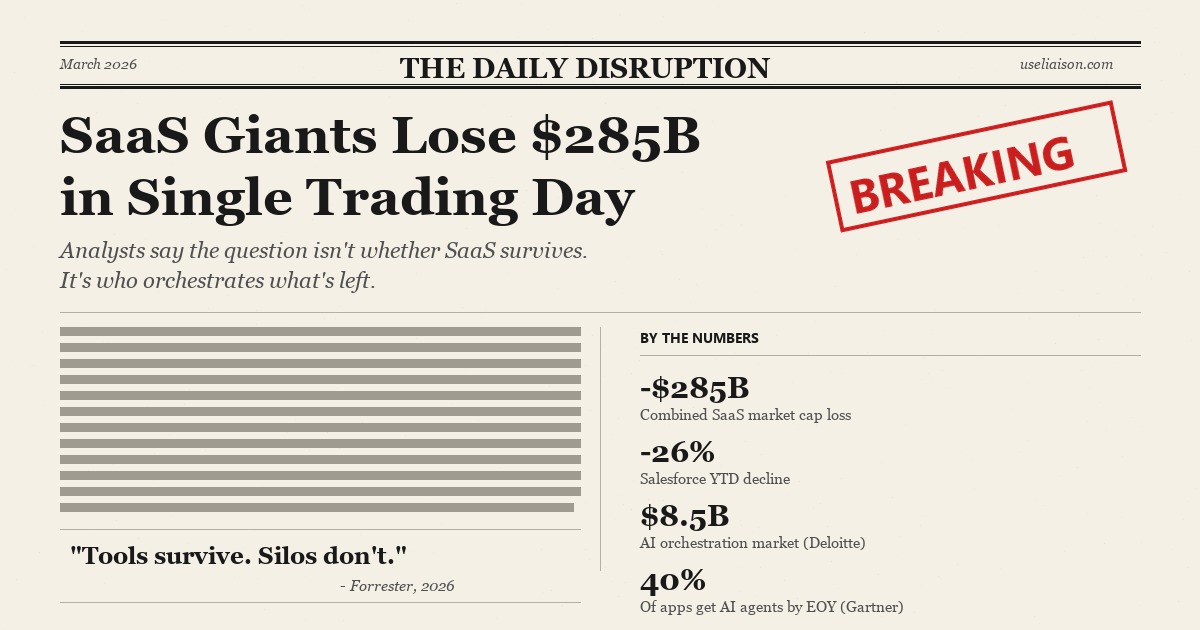
So the software industry lost $285 billion in market cap in a single day a few weeks ago. Salesforce is down 26% year-to-date. Forrester published a piece literally titled "SaaS As We Know It Is Dead." Everyone's calling it the SaaSpocalypse, and the take you're hearing everywhere is that AI agents are going to replace all your software.
That's not what's happening. And if you run a business, the distinction matters.
Software isn't dying. Silos are.
You still need QuickBooks. You still need your CRM. You still need scheduling software and invoicing tools and communication platforms. What's dying is the idea that each one of those tools operates in its own bubble, with its own data, its own login, and its own version of the truth.
The average 25-person business manages 32 different software subscriptions with 18% functional overlap. Workers toggle between applications 1,200 times per day. Four hours per week just reorienting after app switches. 53% of SaaS applications go underutilized or unused.
That's not a software problem. It's a connection problem. The tools work fine individually. It's the spaces between them where everything breaks down.
The Wall Street thesis is half right
Wall Street is correct that per-seat SaaS pricing is under pressure. When AI agents can handle tasks that previously required a human clicking through a CRM, paying $150/seat/month for that CRM starts to look different. Gartner says AI agents will create a $58 billion shake-up in mainstream productivity tools, the first real challenge to that market in 35 years.
But the conclusion that businesses will stop using software altogether is wrong. What happens instead is that the software becomes infrastructure. Plumbing. You still need it, but you interact with it less directly. The layer you actually work with is the intelligence layer on top that orchestrates all of it.
Microsoft figured this out. They launched Copilot Cowork on March 9, an AI layer that sits on top of Outlook, Teams, SharePoint, and Excel and runs multi-step tasks across all of them. The pitch isn't "replace Office." The pitch is "keep Office, but now there's a brain on top of it."
That's also Liaison's pitch. And Deloitte values the AI orchestration market at $8.5 billion in 2026, heading toward $35 billion by 2030. So this isn't a fringe idea. It's where the market is going.
What this means if you run a business
The consolidation conversation used to be "you need fewer tools." Now it's becoming "you need one brain that uses all your tools." Those are very different conversations.
The first one asks you to rip and replace. Find a platform that does CRM and accounting and scheduling and invoicing all in one. The problem is those platforms either don't exist for your industry, or they're ServiceTitan-level complex at $250-400 per tech per month with $5K-50K implementation costs. That's not realistic for a 15-person company.
The second conversation, the orchestration conversation, says keep what you have. Your team already knows how to use Jobber. They already know QuickBooks. Don't make them learn something new. Instead, put an intelligence layer on top that connects everything and starts surfacing the insights that no single tool can see.
Your CRM knows who your customers are. Your accounting system knows what they've paid. Your scheduling tool knows when they were last serviced. Your review platform knows how they feel about you. Right now, those are four separate data sets in four separate apps. Connected with intelligence on top, that becomes: "This customer spent $12K last year, hasn't booked a service in 4 months, and left a 3-star review last time. Here's a retention action."
No single tool gives you that. The orchestration layer does.
Why this matters more for a 20-person company than a 2,000-person one
Enterprise companies have data teams. They have integration engineers. They can build custom pipelines between Salesforce and SAP and whatever else they run. That's why the SaaSpocalypse panic is mostly a Wall Street story about enterprise software valuations.
For a 20-person business, the situation is actually simpler and more urgent at the same time. Simpler because you have fewer tools and cleaner data. More urgent because you don't have a data team, so the only way you get connected intelligence is if someone builds it for you.
Only 7% of businesses using AI have it fully integrated into operations. The barrier isn't cost, it's complexity. People know they need this. They don't know how to get there without hiring engineers or paying consultants $50K.
That's the gap. Not "do businesses need fewer tools" but "who builds the intelligence layer that connects the tools they already have." The SaaSpocalypse isn't about killing SaaS. It's about who orchestrates what survives.
Share this article
Related Articles

The Efficiency Is in Your Role, Not Your Vertical
So Avoca is booking a billion dollars of trade jobs over the phone, and that's real. But it's built for one function in one industry, and your job as the owner is every function at once. That's where the efficiency actually is, and nobody was building for it.

Instinct, Town and Grok Bot Are All Task Assistants. Liaison Is the Digital Version of You.
So 20VC is calling it the $100 billion race between Town, Instinct and Grok Bot, and they are all doing one job. None of them builds a context layer over your business, they rent your inbox. And Grok Bot can only ever be Grok, which is a real problem if what you are selling is an outcome.

The Interface Is Your Phone
This week we turned on something I've wanted since the beginning: you can tell Liaison to text you. It isn't a feature, it's a position on where an owner actually is, which is not in front of a screen.