What Happens When Your Competitor Wires AI Into Everything
Cade Cunningham
Author
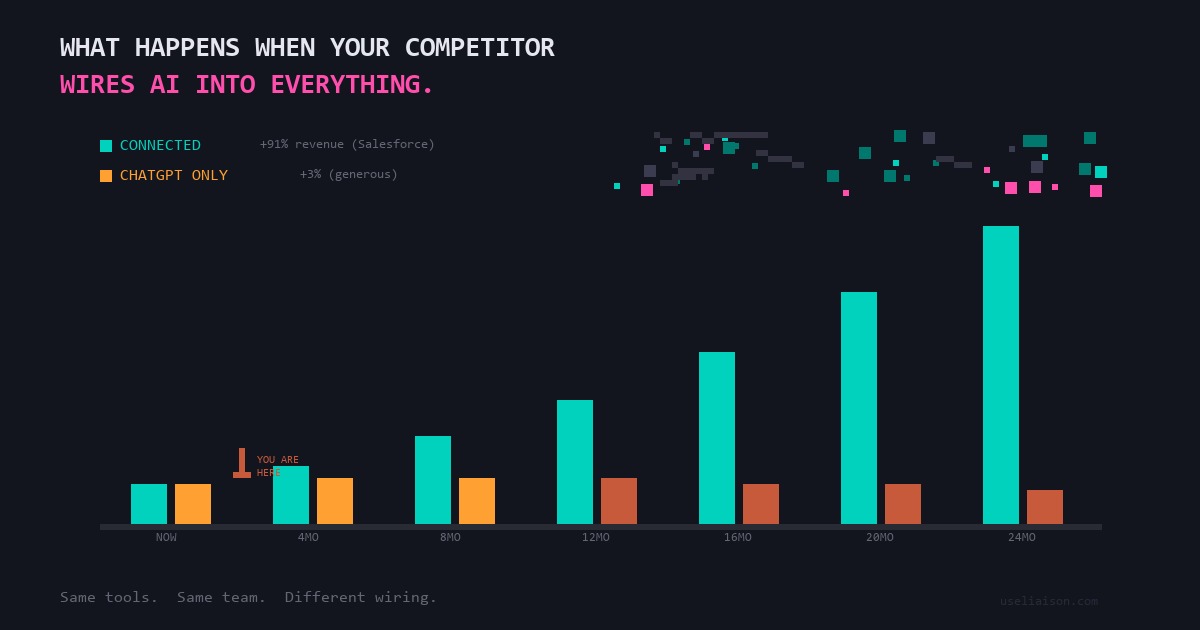
Two businesses. Same industry. Same size, same tools, same revenue, same number of employees. One of them connects their entire operation to an AI layer that watches everything, learns patterns, and flags problems before they become crises. The other one has a ChatGPT subscription and a guy who's pretty good at Excel.
Give it 12 months. The first business knows, in real time, which customers are about to churn based on communication frequency drops. They know their invoicing backlog is growing before it hits cash flow. They know which team members are underperforming relative to their peers, not from a quarterly review, but from continuous pattern recognition across scheduling, customer feedback, and job completion data.
The second business finds out about all of this in a quarterly P&L review. By then it's too late.
The compounding problem
This isn't a one-time advantage. It compounds. Every week the first business runs on operational AI, the system gets smarter. It learns which signals matter, which anomalies are noise, and which patterns predict revenue shifts. By month six, it's catching things the owner would never have noticed. By month twelve, the gap between these two businesses isn't just operational efficiency. It's strategic clarity.
Salesforce surveyed 3,350 business leaders and found that 91% of businesses actively using AI report a revenue boost. But here's the part that matters: 78% of growing businesses plan to increase their AI investment, versus only 55% of declining ones. The businesses that are winning are doubling down. The ones that are losing are still deciding whether to start.
That divergence doesn't slow down. It accelerates.
The market is moving faster than you think
In one week in March 2026: Microsoft launched Copilot Cowork, an AI layer that sits on top of Outlook, Teams, SharePoint, and Excel and orchestrates work across all of them. Monday.com announced Agent Factory, a platform for building and deploying AI agents that manage projects autonomously. Google deployed 8 AI agents to the Pentagon for 3 million workers to handle everything from meeting summaries to budget creation.
That's one week. And Gartner says 40% of enterprise applications will feature task-specific AI agents by the end of this year, up from less than 5% in 2025.
If an organization with 3 million workers needs AI agents to create budgets and manage compliance, your 20-person company does too. The difference is they have dedicated engineering teams to build it. You don't. Which means you need a platform that does it out of the box, right now, without a six-month implementation.
What "falling behind" actually looks like
People hear "you'll fall behind" and think it means being slightly less efficient. That's not what this looks like. Here's what it actually looks like for a 20-person service business that doesn't adopt operational AI in the next 2-3 years.
Your competitor starts quoting jobs 30% faster because their estimating tool feeds directly into their scheduling and invoicing. You're still emailing quotes from a template and manually entering them into QuickBooks.
Your competitor's AI flags a customer who hasn't booked their annual service call, automatically sends a personalized reminder, and books it. You notice the customer churned in Q4 when you're reviewing year-end numbers.
Your competitor knows their Tuesday crew runs 15% more efficient than their Thursday crew and adjusts scheduling accordingly. You think all your crews perform roughly the same because you've never had the data to compare them.
Each of those individually is small. Together, over 24 months, it's the difference between a business that's growing and a business that's wondering why margins keep shrinking.
The uncomfortable timeline
Harvard Business Review published a piece in February 2026 arguing that companies need "agent managers," a role responsible for orchestrating how AI agents learn, collaborate, and work alongside humans. Their finding: uncontrolled proliferation of siloed AI agents actually increases operational friction rather than reducing it.
So it's not enough to just buy AI tools. You need them orchestrated. Connected. Learning from each other. A CRM agent that doesn't talk to your finance agent is just another silo with a better UI.
Only 11% of organizations have actually deployed agentic AI in production. 30% are exploring, 38% are piloting, 14% are "deployment-ready." That means 89% of the market is still figuring it out. The businesses that crack this now get a window that closes fast.
And Gartner projects that 40% of agentic AI projects will fail by 2027, not because the technology doesn't work, but because companies try to automate broken processes. If your invoicing workflow is a mess, automating it with AI just produces mess faster. You have to connect first, normalize second, then apply intelligence. Most people skip straight to "automate" and wonder why nothing changed.
The bottom line
This isn't a technology conversation. It's a survival conversation. Not in the dramatic, headline-grabbing sense. In the slow, compounding, "I don't know why we're losing market share" sense. The kind where you don't realize what happened until the competitor across town is running three crews on the same revenue you need five for.
The tools exist. The data exists. The question is whether you connect them now or watch someone else do it first.
Share this article
Related Articles

The Efficiency Is in Your Role, Not Your Vertical
So Avoca is booking a billion dollars of trade jobs over the phone, and that's real. But it's built for one function in one industry, and your job as the owner is every function at once. That's where the efficiency actually is, and nobody was building for it.

Instinct, Town and Grok Bot Are All Task Assistants. Liaison Is the Digital Version of You.
So 20VC is calling it the $100 billion race between Town, Instinct and Grok Bot, and they are all doing one job. None of them builds a context layer over your business, they rent your inbox. And Grok Bot can only ever be Grok, which is a real problem if what you are selling is an outcome.

The Interface Is Your Phone
This week we turned on something I've wanted since the beginning: you can tell Liaison to text you. It isn't a feature, it's a position on where an owner actually is, which is not in front of a screen.