You Don't Need Another Employee. You Need Your Tools to Talk to Each Other.
Cade Cunningham
Author
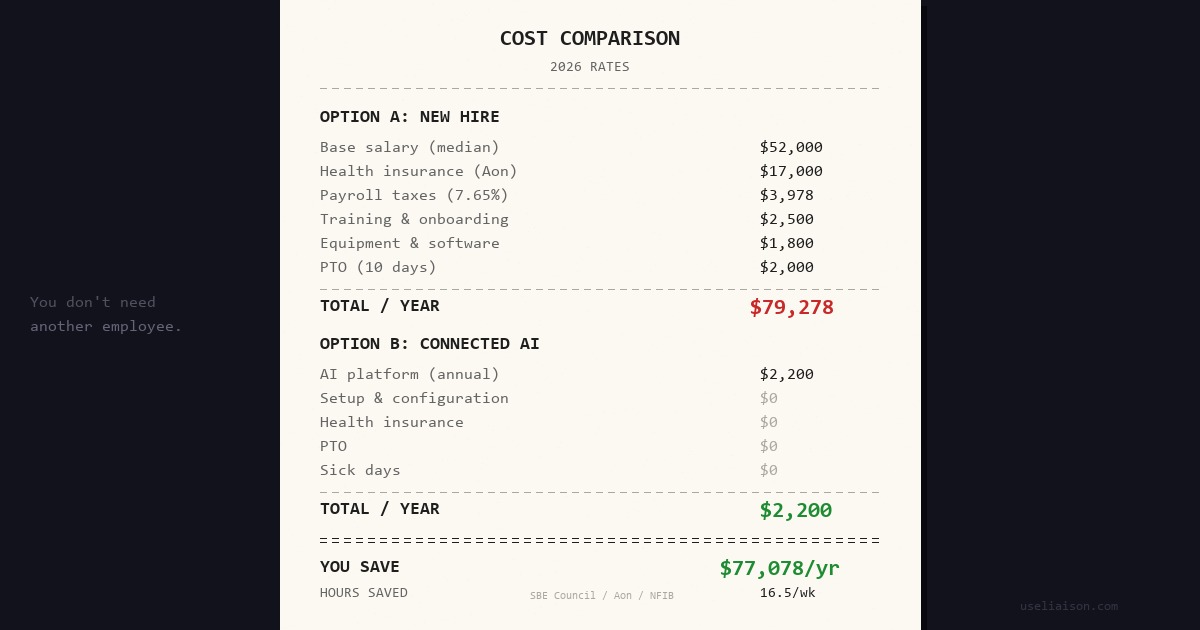
Health insurance crossed $17,000 per employee this year. That's just the insurance. Add salary, payroll taxes, training, management time, and you're looking at $60-90K minimum to put one person in a seat for a 15-person company.
Meanwhile, tariff bills tripled for mid-sized businesses in 2025 according to JPMorgan Chase. 76% of businesses are passing costs to customers. Revenue expectations just hit their lowest point since the pandemic.
So every hire is a bet. A big one. And most of the time, the work you're hiring for isn't work that needs a person. It needs your tools to stop being strangers to each other.
The $60K job that doesn't need to exist
Think about the last operations hire you made. Or the one you're thinking about making right now. What does that role actually do day to day?
Check the CRM for new leads, then manually enter them into the scheduling system. Pull invoicing data from QuickBooks and compile it into a weekly report. Follow up on overdue invoices by cross-referencing the accounting system with the customer database. Check review platforms and flag negative feedback. Update the team spreadsheet with job completion status.
That's not strategic work. That's moving data between apps that should already be talking to each other. And it takes a full-time person because the apps don't talk. So you hire a human router, someone whose entire job is being the middleware between your CRM, your accounting, your scheduling, and your communication tools.
An AI layer connected to those same tools does that work continuously. Not once a day when someone gets to it, but in real time, every hour, learning patterns as it goes.
What connected tools actually replace
This isn't about replacing people. It's about not hiring for roles that shouldn't exist in the first place.
When your scheduling tool talks to your CRM, you don't need someone manually transferring customer data between them. When your accounting system talks to your invoicing platform, you don't need someone running overdue reports every Friday. When your review platform feeds into your customer database, you don't need someone screening Google reviews and flagging issues.
The SBE Council reported on March 11 that businesses using AI tools save an average of 16.5 hours per week. That's two full days. The median AI spend? $2,200 per year.
Compare that to the person you were about to hire at $60K plus $17K in insurance plus $5K in payroll taxes. For less than one month of that hire's fully loaded cost, you get an AI layer that works all year, doesn't take PTO, and gets better every week.
The real problem is nobody showed you what this looks like
When people think "AI for business," they picture ChatGPT. Upload a document, get a summary. Ask it to draft an email. That's fine, but it's a personal productivity tool. It has nothing to do with your operations.
Operational AI looks like this: you connect QuickBooks, your CRM, your scheduling platform, and your communication tools to one intelligence layer. Now that layer watches your business continuously. It notices your invoicing is slipping behind by three days compared to last month. It flags that two customers haven't responded to estimates in over a week. It sees that your revenue is tracking below forecast and correlates it with a drop in completed jobs from one crew.
You didn't ask for any of that. It surfaced because the AI is connected to your actual business data and it's learning what matters.
Only 7% of businesses using AI have reached this level of integration. Not because it's expensive. Not because the technology isn't ready. The Bookipi survey of 2,100 business owners found the barrier is complexity. People don't know where to start. They don't know what "connect your tools to AI" actually means in practice. So they default to what they know: hire another person.
The hiring math doesn't work anymore
Hiring in 2026 doesn't work the way it used to. 46% of business owners report few or no qualified applicants for the roles they need to fill. And 22% of businesses that apply for financing to cover operating costs get nothing. So even if you want to hire, you can't find the right people, and you might not be able to afford them.
The businesses figuring this out are the ones connecting their existing tools and letting AI handle the data routing, the pattern detection, and the early warning signals. They're not replacing their team. They're making each person on the team more effective by eliminating the busywork that eats 16 hours a week.
Your next hire might be necessary. But before you post that job listing, ask yourself: is this role actually about thinking and deciding? Or is it about moving information between systems? Because if it's the second one, you don't need a person. You need your tools to talk to each other.
Share this article
Related Articles

The Efficiency Is in Your Role, Not Your Vertical
So Avoca is booking a billion dollars of trade jobs over the phone, and that's real. But it's built for one function in one industry, and your job as the owner is every function at once. That's where the efficiency actually is, and nobody was building for it.

Instinct, Town and Grok Bot Are All Task Assistants. Liaison Is the Digital Version of You.
So 20VC is calling it the $100 billion race between Town, Instinct and Grok Bot, and they are all doing one job. None of them builds a context layer over your business, they rent your inbox. And Grok Bot can only ever be Grok, which is a real problem if what you are selling is an outcome.

The Interface Is Your Phone
This week we turned on something I've wanted since the beginning: you can tell Liaison to text you. It isn't a feature, it's a position on where an owner actually is, which is not in front of a screen.