The AI Orchestration Layer Is Here. SMBs Just Can't Access It Yet.
Cade Cunningham
Author
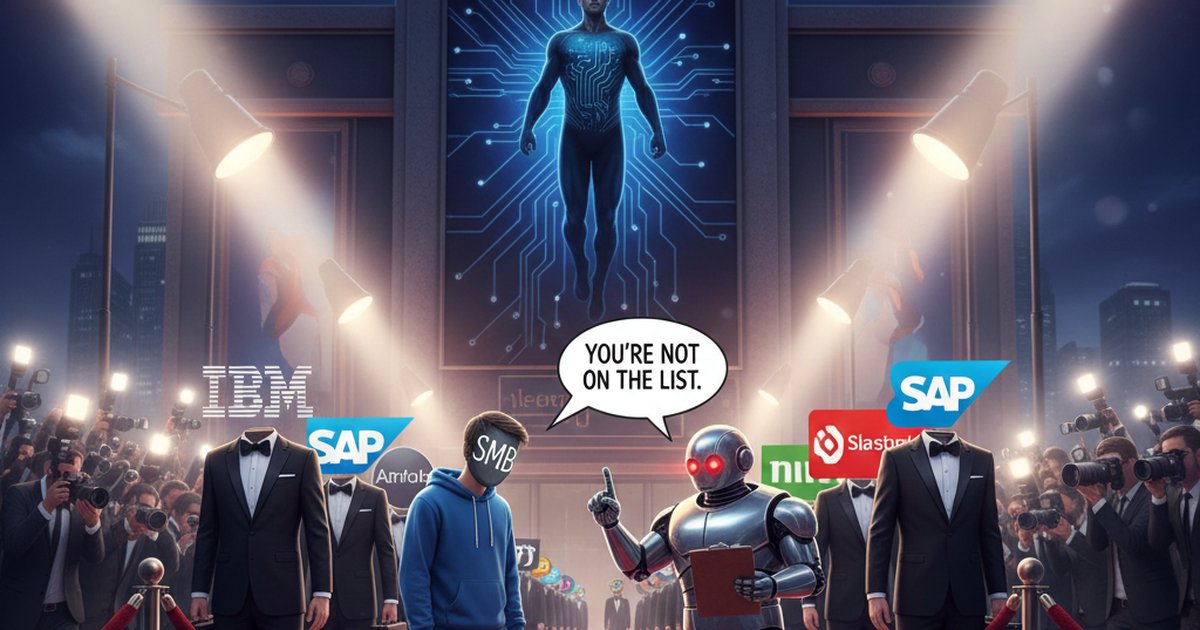
So this week was wild. On February 5th, OpenAI launched Frontier, their enterprise AI orchestration platform. Same week, the stock market had a full panic attack. Thomson Reuters fell 16%. LegalZoom dropped 20%. The market wiped out $285 billion in SaaS market cap in what people are calling the "SaaSpocalypse." Wall Street is pricing in that AI agents are going to eat traditional software alive.
And honestly? Yeah. That's exactly what's happening.
But there's a part of this story nobody's talking about. Every single one of the big AI agent moves over the last few months targets the same customer: enterprises with thousands of employees and millions in software budget. OpenAI Frontier's launch partners are HP, Intuit, Oracle, Uber, and T-Mobile. Fortune 500. Salesforce has been building out Agentforce since late 2024 and it's designed for their existing enterprise CRM users. Microsoft shipped Copilot Agents into Dynamics 365. Google launched Workspace Studio for building AI agents on Gmail and Drive, but good luck making that work without a dedicated IT team.
The 30-person marketing agency? The HVAC company with 12 employees? The law firm with three attorneys and a paralegal? Nobody's building this for them.
The Biggest Validation Week in AI History
I want to be clear about something. What's been happening is a big deal. The largest technology companies on earth have all converged on the same thesis: the future of business software is an AI orchestration layer that connects, manages, and executes workflows across your entire stack.
That's literally what OpenAI said about Frontier. "Connects, manages, and executes workflows across an organization's entire software stack." That's the pitch. Not a chatbot. Not a copilot that helps you write emails. A layer that sits across all your tools and actually runs operations.
The AI orchestration market hit $11.47 billion in 2025 with a 23% compound annual growth rate. Big Tech is pouring $700 billion into AI infrastructure this year. This isn't a trend. It's the new foundation of how software works.
And I've been saying this for months. I wrote about how LLMs and agents are commodities and the real value is in the context layer. I wrote about why you should stop building more automations and start building intelligence across them. This week, every major tech company validated that thesis publicly, with real products and real dollars behind it.
So that feels good. But it also makes the gap more obvious.
Enterprise Gets the Future. SMBs Get Left Behind. Again.
This is the pattern, right? Every major technology shift starts with enterprise and takes 5 to 10 years to trickle down to small business. Cloud computing, CRM, marketing automation, business intelligence. Enterprise got it first. Small businesses got a watered-down version years later, if they got it at all.
AI orchestration is following the same playbook. OpenAI Frontier requires a sales conversation and probably a six-figure annual contract. Salesforce's Agentforce lives inside Salesforce, which costs $150+ per user per month before you even think about the AI add-ons. Microsoft's Copilot Agents require Dynamics 365, which is an enterprise ERP system. Google's Workspace Studio is powerful but assumes you have someone technical enough to build and maintain the agents.
None of this is designed for the business owner who's running QuickBooks, HubSpot, Slack, and a handful of other tools, and just needs them to actually work together intelligently.
And it's not like SMBs don't need this. The average small business runs about 42 SaaS applications. Data lives everywhere. Teams spend hours moving information between systems manually. I wrote about why AI investments fail when data isn't connected, and the core problem hasn't changed. The AI is fine. The data underneath is fragmented across a dozen tools that don't talk to each other.
Enterprise can throw money and implementation teams at that problem. A 20-person company can't.
What Orchestration Actually Means (Without the Enterprise Pricing)
So let me break down what OpenAI Frontier and these other platforms actually do, because the concept itself is exactly right. It's the access that's wrong.
An AI orchestration layer does three things:
It connects to your existing tools. Not replaces them. Connects to them. Your CRM stays your CRM. Your accounting software stays your accounting software. The orchestration layer sits on top and has visibility into all of it. This is the part I keep coming back to. You don't need to rip out your stack. You need a layer that makes your stack intelligent.
It understands context across systems. This is the difference between automation and orchestration. A Zap moves data from point A to point B. An orchestration layer knows that when a deal closes in your CRM, it should check resource availability in your project tool, look at the client's payment history in accounting, flag any open support tickets, and then kick off the right workflow based on all of that context combined. Not five separate automations. One connected understanding. That's what a context graph does.
It learns and improves over time. Every interaction teaches it more about how your specific business operates. What your team accepts, what they reject, what patterns matter. Generic AI gives generic answers. An orchestration layer that's been watching your operations for three months gives answers that are specific to your business, your customers, your workflows.
That's not complicated. That's not something that requires a Fortune 500 budget. That's something every business with more than a handful of tools needs.
Why Nobody Else Is Building This for Small Business
The honest answer? It's harder to build for SMBs than for enterprise.
Enterprise customers have dedicated IT teams who can spend months on implementation. They have standardized tech stacks. They have the budget to pay for professional services. Building an orchestration platform for them means building one integration with Salesforce, one with SAP, one with Workday, and you've covered a huge percentage of your customer base.
Small businesses are messy. One uses HubSpot, the next uses Pipedrive, the next uses Zoho. Accounting could be QuickBooks, Xero, FreshBooks, or a spreadsheet. Project management is Monday, Asana, Trello, Notion, or some combination. There's no standard stack. Every business is different.
So to build a real orchestration layer for SMBs, you need to support a massive number of integrations. You need it to work without a six-month implementation project. You need it to be affordable at SMB price points. You need it to be simple enough that someone without a technical background can actually use it.
That's the hard part. And that's exactly what we built.
What Liaison Is (Now That the Big Players Named the Category)
Liaison connects directly to the business tools you already run and gives you one unified intelligence layer across all of them. We build and maintain those integrations ourselves rather than renting them from a middleman, which is why they go deep instead of wide, and a tool we don't have yet is usually live within a week. Keep your tools. Gain visibility. That's been the pitch since day one.
But I'll be honest, explaining what an AI orchestration layer is has been the biggest challenge in selling this. People hear "orchestration" and their eyes glaze over. They hear "connects your tools" and think we're Zapier. They hear "AI layer" and think we're another chatbot.
OpenAI, Microsoft, Salesforce, and Google have collectively spent billions of dollars explaining the category to the market. They told the world that the future is an AI layer that sits across your entire software stack, connects everything, understands context, and executes workflows intelligently.
They're right. They're just building it for the wrong customer.
Liaison is the same concept, built for the business that doesn't have an IT department, doesn't have a six-figure software budget, and can't wait 18 months for an implementation. You connect your tools, the AI learns your operations, and you get intelligence across your entire business in days, not quarters.
The orchestration layer is here. The biggest companies in tech just proved it. The only question is whether small businesses get access to it or get left behind for another decade.
We're not waiting for the trickle-down. Book 30 minutes with us and we'll show you what AI orchestration looks like when it's built for a business your size.
Share this article
Related Articles

The Best AI for Small Business in 2026, Sorted by the Job You Need Done
So "best AI for small business" has become one of the fastest-growing searches out there this year. Here is how I would sort it: by the job you need done, with real prices and where each kind of tool stops, including ours.

The Efficiency Is in Your Role, Not Your Vertical
So Avoca is booking a billion dollars of trade jobs over the phone, and that's real. But it's built for one function in one industry, and your job as the owner is every function at once. That's where the efficiency actually is, and nobody was building for it.

Instinct, Town and Grok Bot Are All Task Assistants. Liaison Is the Digital Version of You.
So 20VC is calling it the $100 billion race between Town, Instinct and Grok Bot, and they are all doing one job. None of them builds a context layer over your business, they rent your inbox. And Grok Bot can only ever be Grok, which is a real problem if what you are selling is an outcome.