The cash flow statement, explained
A cash flow statement shows where cash came from and where it went over a period, usually a month, a quarter or a year. It starts with the cash you had, lists the cash that came in and went out in three sections, and ends with the cash you have. The closing number is the bank balance.
It exists because profit and cash are different things. The income statement records a sale when you invoice it and a cost when you incur it. The cash flow statement records money only when it moves. A business can show a profit and still miss payroll, and this is the report that shows why.
Liaison does this part of the job, set up with you, for $629 a month. See how.
Why profit is not cash
Most businesses keep their books on the accrual basis: revenue is recorded when the work is done, not when the customer pays, and a cost is recorded when the bill arrives, not when it is paid. That makes the income statement a good picture of whether the business is making money and a poor picture of whether there is money in the bank.
Four things move cash without touching profit: customers paying late, inventory bought and sitting on the shelf, loan principal repaid, and equipment bought outright. Four things touch profit without moving cash: depreciation, a bad-debt write-off, an accrued bonus, and a bill recorded but not yet paid. The cash flow statement reconciles the two.
The three sections
- Operating activities: the cash from running the business. Customer payments in; suppliers, payroll, rent, insurance and taxes out. For a healthy business this is positive, and it is the number to watch.
- Investing activities: cash spent on things that last, such as vehicles, equipment, property and software you build, and cash received from selling them. For a growing business this is usually negative, and that is not a problem by itself.
- Financing activities: cash from and to the people who fund the business. Loans drawn and repaid, a line of credit, owner contributions, and owner draws or distributions.
- The three sections add up to the net change in cash. Opening cash plus the net change equals closing cash, which must match the bank. If it does not, something is misrecorded.
Direct and indirect method
The direct method lists the operating cash receipts and payments themselves: collected from customers, paid to suppliers, paid in wages. It is the easier one to read and the harder one to produce, which is why almost no accounting software defaults to it.
The indirect method starts from net income and adjusts it to cash. Add back the costs that did not use cash, such as depreciation and amortization. Then adjust for working capital: a rise in receivables or inventory used cash, so subtract it; a rise in payables preserved cash, so add it. Your accounting software produces this version, and it is the one your banker and your accountant read.
A worked example
A service business ends the year with net income of $120,000. Depreciation on its trucks and equipment was $15,000, so add it back. Receivables grew by $20,000 because customers paid more slowly, so subtract it. Inventory grew by $5,000, subtract it. Payables grew by $8,000, add it. Operating cash flow is $118,000: $120,000 plus $15,000, minus $20,000, minus $5,000, plus $8,000.
The business bought a truck for $45,000 in cash, so investing activities are minus $45,000. It repaid $24,000 of loan principal and the owner took $30,000 in distributions, so financing activities are minus $54,000. The net change in cash is $118,000 minus $45,000 minus $54,000, which is $19,000. Cash was $41,000 at the start of the year and $60,000 at the end. The statement explains the whole $19,000, and the $120,000 of profit became $19,000 of cash.
How to read it as an owner
- Operating cash flow should be positive and close to net income, or above it. If it runs well below net income for several periods, customers are paying slowly or inventory is building, and the receivables aging report will show which.
- A negative investing section is normal when you are buying vehicles and equipment to grow. A positive one means you sold assets, which is worth a second look.
- Read financing for what it is funding. Borrowing to buy a truck is one thing; borrowing to cover payroll is another, and the operating section will have told you first.
- Look at it monthly, not yearly. The annual statement is a history; the monthly one is a warning.
- Pair it with a 13-week cash forecast. The statement says what happened; the forecast says whether the next payroll, tax payment and loan instalment are covered.
The part Liaison does
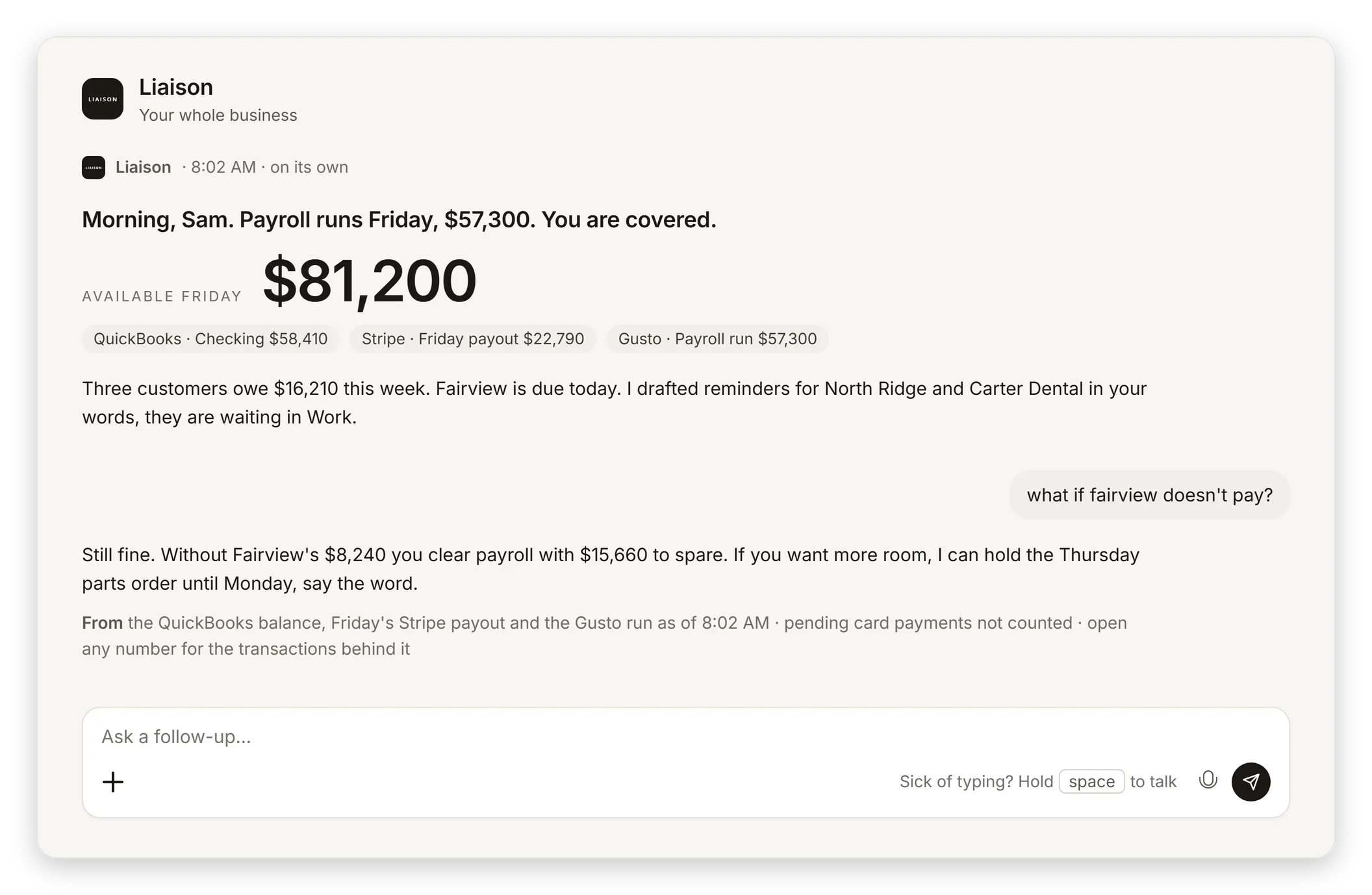
Liaison reads your books, your bank and your payment processors together, so the cash position is one number with the transactions behind it. Ask whether you can make payroll Friday and it answers from the balance, the payouts on the way and the payroll run, with pending card payments left out. It tells you the morning receivables start building, or a payout does not land. The statement is a report you read; this is the same information, every morning, before you ask.
Liaison watches the cash, set up with you, for $629 a month.
- Reads the books, the bank and the payment processors together, so the cash position is one number with the transactions behind it.
- Answers whether you can make payroll Friday before you ask, with pending card payments left out.
- Flags receivables building and a payout that did not land, the morning it happens.
On Professional we connect your tools, bring your data in and set up the first rules with you. Anything that moves money waits for your yes.
“Cut our month-end close from 4 days to 4 hours.” Marcus C., owner
$629 a month, or $500 a month on a 12-month term. Prefer to start on your own? Starter is $149 a month, self-serve, with a free trial first: 7 days, no card. More: AI CFO.
Works with the tools you already run
Liaison connects to these and more with access you grant, and reads them together with the rest of your business. Each page shows what it reads and does in that tool.
Questions
What does a cash flow statement show?
Where cash came from and where it went over a period, in three sections: operating, investing and financing. It starts with the opening bank balance and ends with the closing one.
What is the difference between a cash flow statement and an income statement?
The income statement records revenue when earned and costs when incurred, so it shows profit. The cash flow statement records money only when it moves, so it shows cash. A profitable business can have negative cash flow in a period, and the reverse.
What is operating cash flow?
The cash generated by running the business: customer payments in, less suppliers, payroll, rent and taxes out. Under the indirect method it is net income plus non-cash costs, adjusted for changes in receivables, inventory and payables.
Can a profitable business have negative cash flow?
Yes, and it is common. Receivables growing, inventory bought ahead of sales, loan principal repaid and equipment bought outright all use cash without reducing profit.
What is the indirect method?
Starting from net income and adjusting it to cash: add back depreciation and other non-cash costs, subtract increases in receivables and inventory, add increases in payables. It is the method your accounting software produces.
More from Liaison
See it on your own business.
Thirty minutes with us, on your own tools. Bring the thing that eats your evenings and watch it get handled from your own inbox, calendar and books.
Professional is $629 a month and we set it up with you. Starter is $149 a month, self-serve, with the free trial first: 7 days, no card. Every plan is on the pricing page.