Free cash flow, explained
Free cash flow is the cash a business generates after paying for its operations and for the equipment it needs to keep running. It is what is left to repay debt, pay the owners, or keep as a cushion. Of all the numbers in a set of accounts, it is the one that says whether the business is actually producing money.
The formula is short: operating cash flow minus capital expenditures. Both numbers come straight from the cash flow statement.
Liaison does this part of the job, set up with you, for $629 a month. See how.
The formula
Free cash flow equals cash from operating activities minus capital expenditures. Operating cash flow is the first section of the cash flow statement. Capital expenditures are the cash spent on long-lived assets in the investing section: vehicles, equipment, property, major software.
Some owners subtract only the maintenance capex, the spending needed to keep the current business running, and treat growth capex separately. That is a fair refinement if you can tell the two apart. The plain version, all capex, is the one lenders and buyers use.
A worked example
A service business with $1,400,000 of revenue reports net income of $120,000 and operating cash flow of $118,000, after adding back $15,000 of depreciation and adjusting for a $20,000 rise in receivables, a $5,000 rise in inventory and an $8,000 rise in payables. It bought a truck for $45,000. Free cash flow is $118,000 minus $45,000, which is $73,000.
The free cash flow margin is free cash flow divided by revenue: $73,000 divided by $1,400,000, about 5.2%. Out of that $73,000 the business repaid $24,000 of loans and the owner drew $30,000, leaving $19,000 added to the bank. The profit was $120,000; the money the owner could actually take without weakening the business was closer to $73,000.
Free cash flow, profit and EBITDA
- Net income is profit after every accounting charge, including non-cash ones like depreciation. It does not count the cash tied up in receivables and inventory, or the cash spent on equipment.
- EBITDA adds interest, taxes, depreciation and amortization back to profit. It is a measure of operating earnings before the cost of the assets and the debt, which is exactly why it overstates the cash available to an owner who has both.
- Free cash flow counts the working capital and the capex. It is the strictest of the three and the closest to the money you can spend.
- When the three diverge, the cash flow statement says why: slow customers, inventory, or a year of heavy equipment purchases.
What a good number looks like
Positive, and growing with the business. Free cash flow margins vary widely by industry, from low single digits in distribution and construction to twenty percent and more in software and professional services, so the useful comparison is with your own prior periods. The test that matters for a small business is simpler than a benchmark: does free cash flow cover the loan payments and the owner draws you plan to take, with something left over? If it does not, the business is funding those from its cushion or from new borrowing, and the cash flow statement will show which.
A negative year is not always a warning. A business that bought a building or a fleet will show negative free cash flow in that year and higher operating cash flow in the ones that follow. Several negative years with no such purchase is the warning.
How to improve it
- Collect faster. Every day off your days sales outstanding is cash that was sitting with customers. Invoice the day the work is done and follow up on a schedule.
- Pay suppliers on their terms, not before. Early payment is a loan to your supplier unless they discount for it.
- Hold less inventory, or hold it for less time. Stock on the shelf is cash on the shelf.
- Separate the capex you need from the capex you want, and time the latter for the periods that can carry it.
- Price for the margin you need. Free cash flow problems that persist through good collections and lean inventory are usually pricing problems.
The part Liaison does
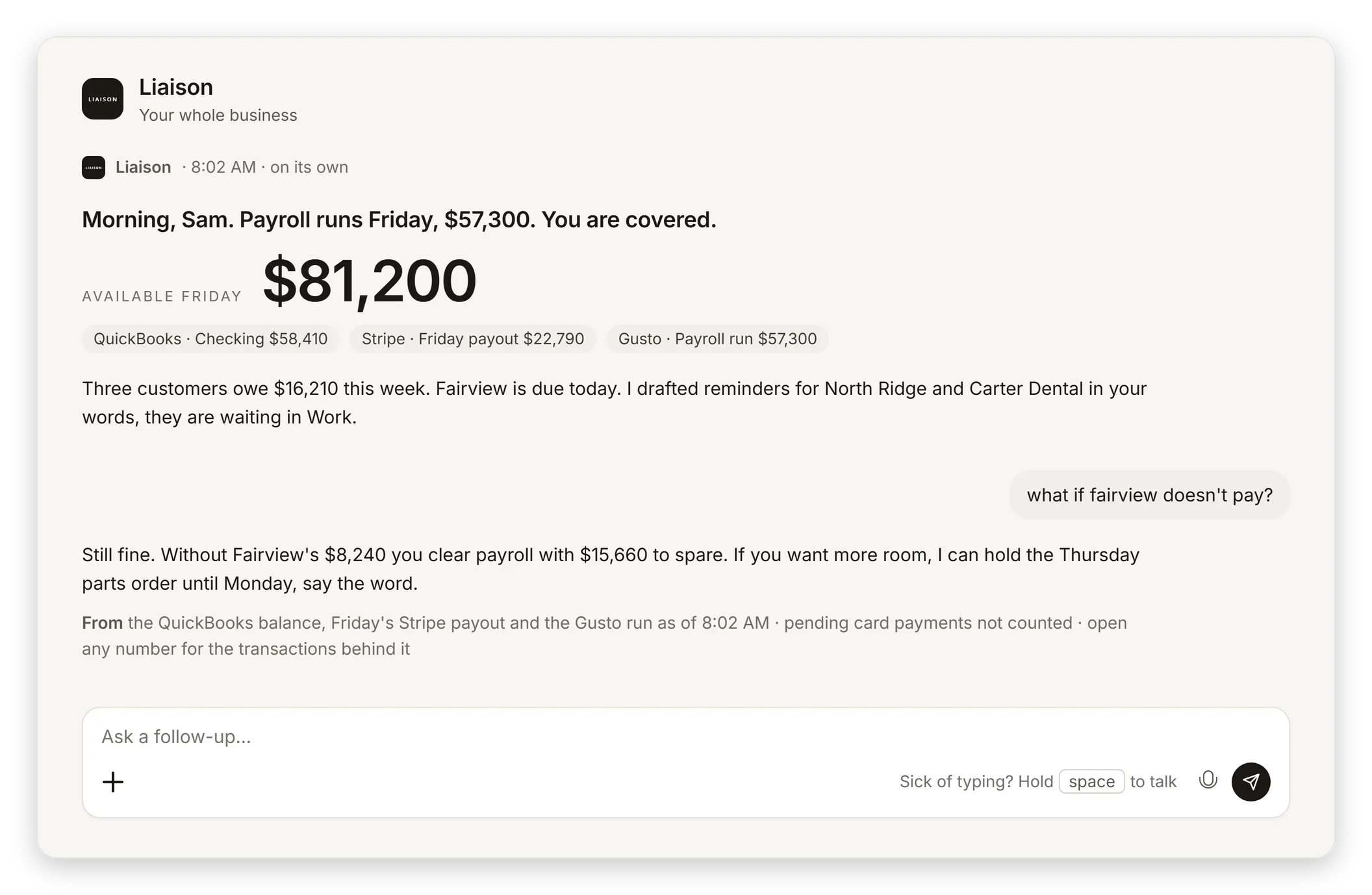
Most of free cash flow is collected, not calculated. Liaison reads your books and your inbox together and chases every open invoice in your voice, one reminder per customer matched to how each one usually pays. It matches payouts and deposits to the invoices they paid and flags the short-pays. And it answers, from the balance, the payouts on the way and the bills due, whether the next payroll, loan payment and owner draw are covered. The judgment about what to spend stays with you; the collecting and the counting do not have to.
Liaison keeps the cash flowing, set up with you, for $629 a month.
- Chases every open invoice in your voice, one reminder per customer, so receivables stop eating your cash.
- Matches payouts and deposits to the invoices they paid and flags the short-pays.
- Answers whether the next payroll, loan payment and owner draw are covered, with the transactions behind it.
On Professional we connect your tools, bring your data in and set up the first rules with you. Anything that moves money waits for your yes.
“Cut our month-end close from 4 days to 4 hours.” Marcus C., owner
$629 a month, or $500 a month on a 12-month term. Prefer to start on your own? Starter is $149 a month, self-serve, with a free trial first: 7 days, no card. More: AI CFO.
Works with the tools you already run
Liaison connects to these and more with access you grant, and reads them together with the rest of your business. Each page shows what it reads and does in that tool.
Questions
What is the free cash flow formula?
Operating cash flow minus capital expenditures. Both come from the cash flow statement: operating cash flow is the first section, capital expenditures are the asset purchases in the investing section.
Is free cash flow the same as profit?
No. Profit records revenue when earned and includes non-cash charges like depreciation. Free cash flow counts only cash, including the cash tied up in receivables and inventory and the cash spent on equipment. It is usually the smaller number.
Is negative free cash flow bad?
Not always. A year with a large equipment or property purchase will be negative and is normal. Negative free cash flow for several years with no such purchase means the business is not producing cash, and the cash flow statement will show whether customers, inventory or margins are the reason.
What is a good free cash flow margin?
It varies by industry, from low single digits in distribution and construction to twenty percent or more in software and professional services. For a small business the practical test is whether free cash flow covers planned loan payments and owner draws with something left over.
What is the difference between free cash flow and EBITDA?
EBITDA is profit before interest, taxes, depreciation and amortization, so it ignores the cost of the assets and the debt. Free cash flow counts the cash spent on assets and the cash tied up in working capital. For an owner with trucks and a loan, free cash flow is the honest number.
More from Liaison
See it on your own business.
Thirty minutes with us, on your own tools. Bring the thing that eats your evenings and watch it get handled from your own inbox, calendar and books.
Professional is $629 a month and we set it up with you. Starter is $149 a month, self-serve, with the free trial first: 7 days, no card. Every plan is on the pricing page.