Accounts receivable, explained
Accounts receivable is the money customers owe you for work you have already done or goods you have already delivered. You sent the invoice; they have not paid yet. On the balance sheet it is a current asset, because it should turn into cash within a year, usually within a month or two.
It is also the most common reason a profitable business runs out of cash: the sales are real, the invoices are out, and the money has not arrived.
Liaison does this part of the job, set up with you, for $629 a month. See how.
The definition
When you invoice a customer on credit terms, say net 30, you record revenue at once and record the same amount as a receivable. When the customer pays, the receivable goes down and cash goes up. The total of every unpaid invoice at a moment in time is your accounts receivable balance. "AR" is the shorthand, and "receivables" means the same thing.
Accounts payable is the mirror image: the money you owe your suppliers for what they have delivered to you. Receivable is what comes in; payable is what goes out.
Accounts receivable turnover: the formula
Accounts receivable turnover tells you how many times a year you collect your average receivables. Net credit sales divided by average accounts receivable. Average accounts receivable is the opening balance plus the closing balance, divided by two.
Worked example: a business invoices $600,000 on credit in a year. Receivables were $40,000 at the start of the year and $60,000 at the end, so the average is $50,000. Turnover is $600,000 divided by $50,000, which is 12. The business collects its receivables about twelve times a year, or roughly once a month.
Days sales outstanding
Days sales outstanding, or DSO, turns the same idea into days: 365 divided by the turnover. With a turnover of 12, DSO is about 30 days, so a customer takes a month on average to pay. If your terms are net 30 and your DSO is 30, you are collecting on time. If your DSO is 52, your customers are taking three extra weeks, and you are financing them for free.
The quicker way, month by month: accounts receivable at the end of the month, divided by that month’s credit sales, times the days in the month.
The aging report
- An aging report sorts every open invoice by how long it has been outstanding: current, 1 to 30 days past due, 31 to 60, 61 to 90, over 90.
- The over-90 column is the one to watch. Invoices that old are collected far less often, and most businesses write a share of them off.
- Run it weekly, not at month end. A customer who is 35 days late this week is 65 days late in a month.
- Read it by customer, not just by total: one slow payer with five invoices is a different problem from five customers each a little late.
How to keep receivables current
- Invoice the day the work is done. Every day between finishing and invoicing is a day added to your DSO before the customer has done anything.
- Put the due date, the amount and how to pay in the first line of the invoice email, and take card and bank payments online.
- Follow up on a schedule: a reminder a few days before the due date, one on the due date, and one each week after, written for the customer, firmer each time.
- Reconcile payments the day they land, so you never chase an invoice that was paid.
- Deposits and progress billing on larger jobs, so the receivable never grows past what you can afford to wait for.
The part Liaison does
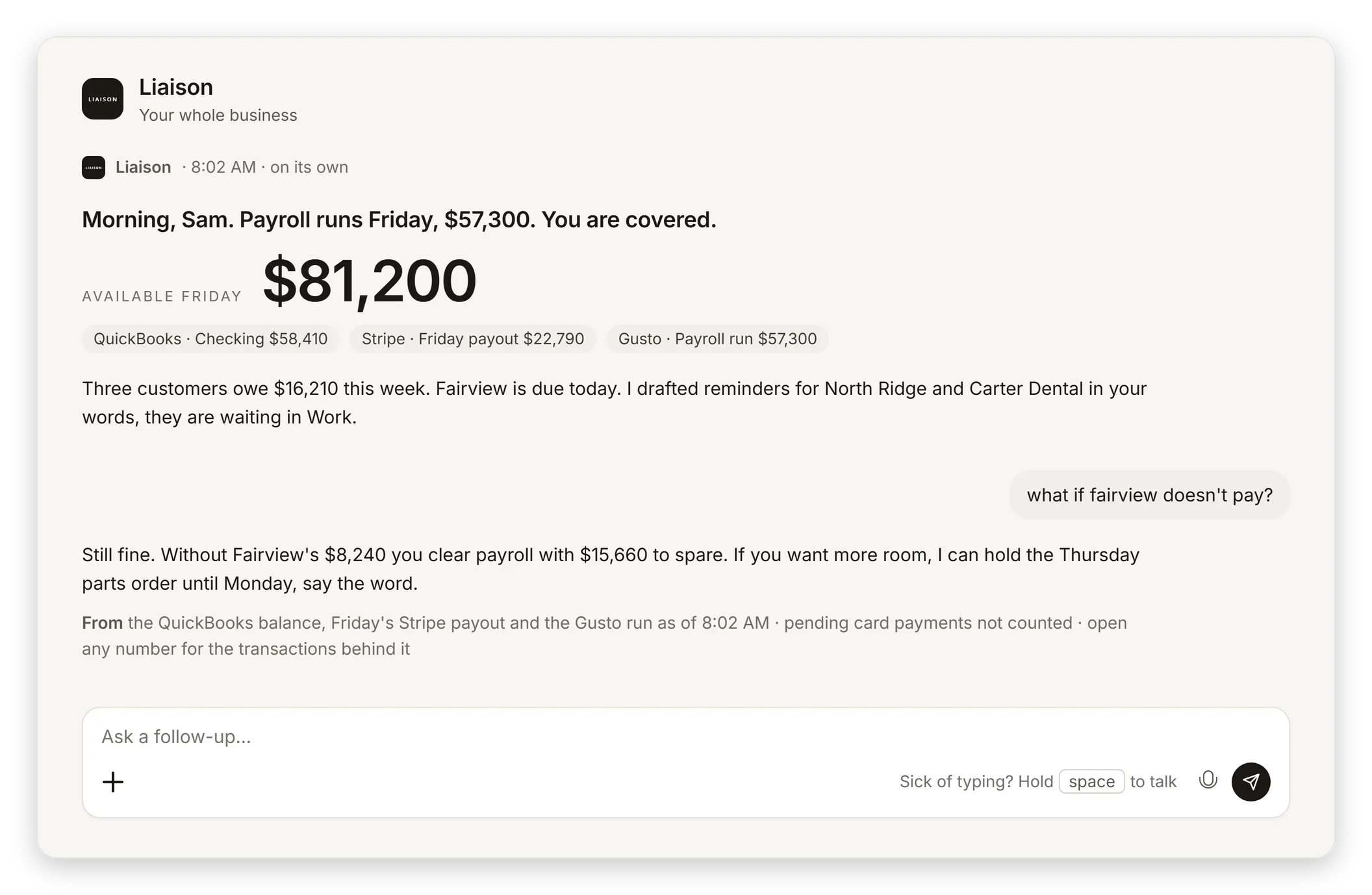
Liaison reads your books and your inbox together, so it knows which invoices are open, who has been reminded and who has gone quiet. It sends the reminders in your voice, one per customer, matched to how each one usually pays; it matches payouts and deposits to the invoices they paid; and every morning it gives you the aging report with the names on it. Collecting the money is a routine; the judgment about a customer stays with you.
Liaison collects it. Your receivables, run and set up with you, for $629 a month.
- Sends every invoice reminder in your voice, one per customer, matched to how each one usually pays.
- Matches payouts and deposits to the invoices they paid and flags the short-pays.
- Gives you the aging report every morning with the names on it.
On Professional we connect your tools, bring your data in and set up the first rules with you. Anything that moves money waits for your yes.
“Cut our month-end close from 4 days to 4 hours.” Marcus C., owner
$629 a month, or $500 a month on a 12-month term. Prefer to start on your own? Starter is $149 a month, self-serve, with a free trial first: 7 days, no card. More: AI bookkeeper.
Works with the tools you already run
Liaison connects to these and more with access you grant, and reads them together with the rest of your business. Each page shows what it reads and does in that tool.
Questions
What is accounts receivable in simple terms?
Money your customers owe you for work you have already done or goods you have already delivered. You have invoiced; they have not paid yet. It sits on the balance sheet as a current asset.
What is the accounts receivable turnover formula?
Net credit sales divided by average accounts receivable, where average accounts receivable is the opening balance plus the closing balance, divided by two. A turnover of 12 means you collect your receivables about twelve times a year.
What is a good days sales outstanding?
Close to your payment terms. If you invoice on net 30, a DSO near 30 means customers pay on time; a DSO well above it means you are carrying your customers. Businesses that take card payment at the point of sale can run a DSO near zero.
Is accounts receivable revenue?
No. Revenue is recorded when the sale is made; the receivable is the unpaid part of that revenue. Invoiced is not the same as collected, and paid is not the same as cash in the bank until the payout lands.
What is the difference between accounts receivable and accounts payable?
Receivable is what customers owe you; payable is what you owe suppliers. Both are current items on the balance sheet, on opposite sides.
More from Liaison
See it on your own business.
Thirty minutes with us, on your own tools. Bring the thing that eats your evenings and watch it get handled from your own inbox, calendar and books.
Professional is $629 a month and we set it up with you. Starter is $149 a month, self-serve, with the free trial first: 7 days, no card. Every plan is on the pricing page.