Everyone Shipped AI Agents This Week. They All Missed the Point.
Cade Cunningham
Author
In the last 72 hours, three major AI companies shipped agent platforms. Notion launched Custom Agents on February 24th. Perplexity dropped "Computer" on the 25th, orchestrating 19 AI models simultaneously. Anthropic expanded Claude Cowork with 13 new enterprise plugins on the 24th. This follows OpenAI's Frontier platform from February 5th. Add in Salesforce's Agentforce, Microsoft's Copilot Agents, HubSpot's Breeze, Monday.com's agent builder, and you start to lose count.
Everyone is shipping agents. And they're all building the same thing.
The Pattern Nobody's Talking About
So I spent the last week looking at these products and reading every piece of coverage I could find. And they all have something in common: you have to tell them what to do.
OpenAI Frontier lets you build and deploy agents across your enterprise stack. Powerful. But you configure the agents, define their tasks, and trigger execution. Their COO, Brad Lightcap, said it plainly last week: "We have not yet really seen AI penetrate enterprise business processes." Then they announced consulting partnerships with McKinsey and BCG to help enterprises figure out what to even use agents for. That tells you everything.
Claude Cowork gives you an agent that works on your files, breaks tasks into steps, and executes. But you set it a task. Every time. It waits for you.
Perplexity Computer takes a goal, decomposes it across 19 models, runs it in a sandboxed VM. Impressive engineering. Their CEO, Aravind Srinivas, framed it himself: "Files, tools, memory, and models, orchestrated together, working for you." Working for you. When you tell it to.
Even Notion's Custom Agents, which are the closest to proactive (they run on triggers and schedules without prompting), only operate within Notion's ecosystem plus a handful of connected tools.
Every single one of these platforms is reactive. You prompt, it executes. You ask, it answers. The AI industry just spent billions building a better question-answering machine.
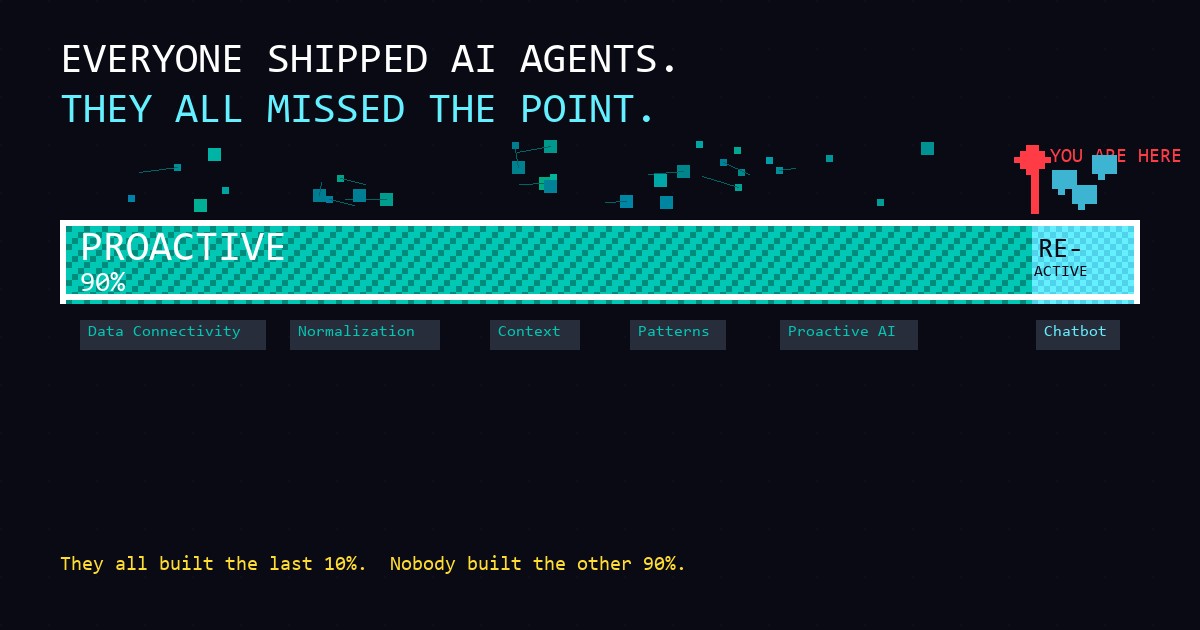
And that's maybe 10% of what your business actually needs.
The Plumber Who Doesn't Know What to Ask
I keep coming back to this plumbing company I talked to last month. Fifteen employees. 340 open quotes sitting in ServiceTitan. Nobody's following up on half of them. Not because they're lazy, but because the person who handles follow-ups also answers phones, schedules techs, and deals with billing disputes.
If you handed that person Claude Cowork or Perplexity Computer, you know what would happen? Nothing. Because they don't know they have a follow-up problem. The data is scattered across ServiceTitan, QuickBooks, Gmail, and a whiteboard. Nobody has synthesized it. Nobody has said "hey, you have 340 open quotes and 12 of them are from repeat customers who've spent $15K with you in the last year, and those 12 haven't been touched in three weeks."
That insight requires something none of these agent platforms provide. It requires an AI that already knows your business.
82% of the smallest businesses say AI "isn't applicable" to them. That's not a technology problem. It's an awareness problem. They can't ask for what they don't know exists. And reactive agents can't help with that, because reactive agents wait for instructions.
The 90% Nobody's Building
So here's what I think is actually going on. The entire AI industry is focused on the chat layer. The prompt. The interface where a human types a question and gets an answer. That layer is getting incredible. Multi-model orchestration, sandboxed execution, persistent memory, tool use. Real progress.
But that's the last 10% of the value stack. The other 90% is invisible, and almost nobody is building it for small businesses.
Data connectivity. Connecting all your tools into one data plane. 94% of AI leaders say their data infrastructure isn't ready for AI. For a 20-person company using QuickBooks, Jobber, Gmail, HubSpot, and Slack, "not ready" means those five tools might as well be on different planets.
Data normalization. Making raw data consistent and AI-readable. Only 12% of organizations have data of sufficient quality for effective AI. The other 88% have "Customer" in one tool and "Contact" in another and "Account" in a third, all meaning the same thing in different formats.
Context building. Understanding YOUR specific business. Not generic small business patterns. Your team, your tools, your customers, your seasonal rhythms. Josh Bersin calls this the "digital twin," an AI that ingests every part of your working life and builds a representation of how your business actually operates.
Pattern learning. Knowing what "normal" looks like for you. Your average deal cycle. Your typical monthly expenses. Your team's capacity. Without a baseline, no AI can tell you when something is off.
Proactive surfacing. This is the part that matters most and exists least. An AI that says "your cash flow is going to be tight in three weeks because two large invoices are overdue and your seasonal dip starts next month" without being asked. An AI that notices your best customer hasn't placed an order in 45 days and flags it before you lose them. Proactive outreach drives 48% higher revenue per interaction and 81% of companies report improved customer satisfaction from it. The data is clear. Telling people what they need to know beats waiting for them to ask.
AI Is a Complement. That Means You Need More Intelligence, Not Less.
There's a Citadel Securities research note from February 24th that frames this well. Frank Flight argues AI follows the same pattern as Microsoft Office. When Office shipped, everyone panicked about job losses. But "ex post, it appears a clear complement." People consumed more capability, not less labor. Productivity went up, and so did demand.
HBR published a study this month showing the same thing: AI doesn't reduce work, it intensifies it. People work faster, take on broader scope, extend into more hours.
So the plumbing company that adopts AI doesn't shrink. It takes on more jobs, more customers, more complexity. Which means it needs MORE operational intelligence, not less. The question isn't "will AI replace my business?" It's "who's going to help me run the bigger business that AI makes possible?"
And the answer isn't a chatbot you have to remember to prompt.
What Your Business Actually Needs
I've written about this before: the models are commodities. Perplexity's CEO literally said it. "When models specialise, they just become tools." OpenAI, Anthropic, Google, they're all converging on the same capabilities. The moat isn't the model.
The moat is context. Knowing your business. And that requires the boring, invisible work that nobody talks about at a product launch. Connecting your tools, normalizing the data, building a context graph of your specific operations, learning your patterns over months, and proactively surfacing what matters before you think to ask.
I wrote about why AI investments fail when the data isn't ready. That's still the fundamental problem. And I wrote about why more automations aren't the answer. The answer is intelligence across your entire operation.
Your business doesn't need another chatbot. It doesn't need a $200/month AI that waits for you to have a brilliant prompt idea at 11pm. It needs a digital version of you. One that knows your business like you do, sees across all your tools like you wish you could, and tells you what you need to know before you ask.
That's not the last 10% everyone's building. That's the other 90% that almost nobody is.
Book 30 minutes and we'll show you what it looks like when AI actually knows your business instead of waiting for you to explain it.
Share this article
Related Articles

The Best AI for Small Business in 2026, Sorted by the Job You Need Done
So "best AI for small business" has become one of the fastest-growing searches out there this year. Here is how I would sort it: by the job you need done, with real prices and where each kind of tool stops, including ours.

The Efficiency Is in Your Role, Not Your Vertical
So Avoca is booking a billion dollars of trade jobs over the phone, and that's real. But it's built for one function in one industry, and your job as the owner is every function at once. That's where the efficiency actually is, and nobody was building for it.

Instinct, Town and Grok Bot Are All Task Assistants. Liaison Is the Digital Version of You.
So 20VC is calling it the $100 billion race between Town, Instinct and Grok Bot, and they are all doing one job. None of them builds a context layer over your business, they rent your inbox. And Grok Bot can only ever be Grok, which is a real problem if what you are selling is an outcome.