Every Platform Shipped AI Agents This Month. None of Them Talk to Each Other.
Cade Cunningham
Author
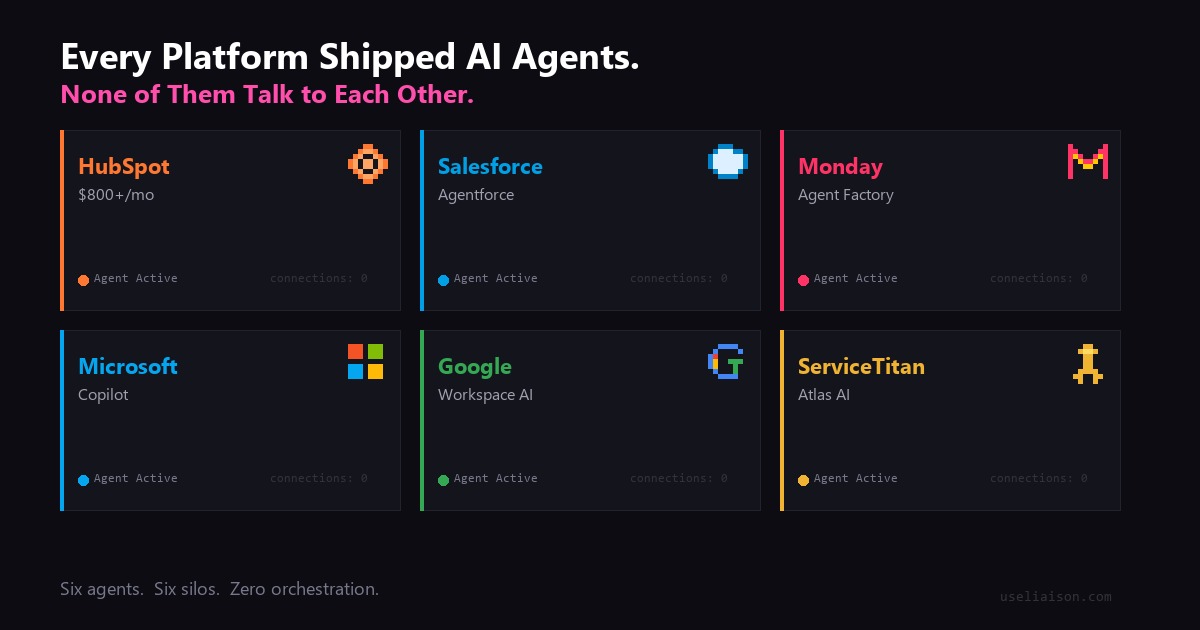
In one week in March 2026, this happened:
Microsoft launched Copilot Cowork, an AI layer on top of Office that runs background tasks across Outlook, Teams, SharePoint, and Excel. Monday.com announced Agent Factory, a standalone platform for building and deploying AI agents that manage projects autonomously. Google deployed 8 ready-made AI agents to the Pentagon for 3 million workers. HubSpot paywalled their Breeze AI agents behind $800+/month tiers. Salesforce shipped Agentforce Builder with a new scripting language on February 23. NVIDIA announced NemoClaw, an open-source agent platform, for Jensen Huang's GTC keynote on March 16.
Everyone is shipping AI agents. That part is real. The problem is what they're not shipping.
Each agent lives in its own box
HubSpot's Breeze agents can do four things: generate content, prospect leads, handle customer service, and enrich data. All within HubSpot. They can't see your QuickBooks. They can't read your scheduling tool. They don't know what your team discussed in Slack.
Salesforce's Agentforce agents work within Salesforce data. If you want them to reference your accounting system or your project management tool, you need a developer writing Agent Script to build custom integrations. For a 20-person company that doesn't have a Salesforce admin, that's a non-starter.
Monday.com's Agent Factory creates agents that manage Monday boards. They can flag project bottlenecks and monitor task progress, which is useful. But they have no concept of your revenue, your customer health, or your operational efficiency. They see boards. That's it.
Even Microsoft's Copilot Cowork, the most impressive of the bunch, only orchestrates across Microsoft's own ecosystem. If your accounting is in QuickBooks, your CRM is in HubSpot, and your scheduling is in Jobber, Copilot Cowork can't help you. It doesn't speak those languages.
The walled garden problem got worse, not better
So what actually happened this month is that every major platform built AI agents that make their own product stickier. That's it. HubSpot agents keep you in HubSpot. Salesforce agents keep you in Salesforce. Monday agents keep you in Monday.
Harvard Business Review published a piece in February warning exactly about this. Their finding: uncontrolled proliferation of siloed AI agents actually increases operational friction rather than reducing it. You end up with five different AI assistants, each looking at a slice of your business, none of them aware of what the others are seeing.
That's not intelligence. That's fragmentation with better marketing.
Over 80% of organizations say connectivity to applications and contextual data is very or moderately important for AI orchestration to work. And yet only 8% have actually implemented enterprise-wide orchestration. Everyone knows the agents need to talk to each other. Nobody is building that.
What cross-platform intelligence actually means
The insight that matters isn't inside any one tool. It's in the connections between them.
Your CRM shows a customer hasn't responded to a proposal in 10 days. Fine. Your scheduling tool shows you have capacity opening up next week. Fine. Your accounting system shows revenue is tracking 12% below forecast this month. Fine. Each of those is a separate data point in a separate app.
Connected with intelligence on top, those three signals become one action: "Revenue is below forecast because three proposals are stalled. You have crew capacity next week. Here's a follow-up sequence for those three customers with available time slots."
No single vendor's AI agent can produce that insight. It requires context from the CRM, the scheduling tool, and the accounting system simultaneously. And it requires a layer that understands the relationships between those data points, not just the data points themselves.
The pricing tells you everything
Look at what these platforms charge for AI:
HubSpot Breeze agents require Professional tier at $800+/month. Salesforce Agentforce starts at $125/user/month as an add-on, or $550/user/month for the full edition. ServiceTitan Atlas runs $250-400 per technician per month with $5K-50K implementation. Microsoft Copilot Cowork is $30-99/user/month but only for the Microsoft ecosystem.
For a 15-person company, you're looking at $12,000-$100,000 per year for AI that only sees one tool. And if you use HubSpot for CRM, QuickBooks for accounting, and Jobber for scheduling (which most service businesses do), you'd need AI agents from three different vendors, none of which communicate with each other.
That's not a strategy. That's three separate expenses producing three separate views of your business.
The layer that's missing
Deloitte projects AI agent orchestration at $8.5 billion in 2026, growing to $35 billion by 2030. 90% of leaders are using or exploring multi-agent systems, but only 19% are actually using them today.
The gap between "exploring" and "using" is the orchestration layer. The thing that connects HubSpot's data to QuickBooks' data to Jobber's data and builds intelligence across all of it. Not another walled garden. Not another vendor lock-in. A platform-agnostic brain that sits on top of whatever you already run.
Every platform shipped AI agents this month. None of them solved the actual problem. The problem was never "my CRM needs to be smarter." The problem was "my tools don't talk to each other, and I can't see my business as a whole."
That problem is still wide open.
Share this article
Related Articles

The Efficiency Is in Your Role, Not Your Vertical
So Avoca is booking a billion dollars of trade jobs over the phone, and that's real. But it's built for one function in one industry, and your job as the owner is every function at once. That's where the efficiency actually is, and nobody was building for it.

Instinct, Town and Grok Bot Are All Task Assistants. Liaison Is the Digital Version of You.
So 20VC is calling it the $100 billion race between Town, Instinct and Grok Bot, and they are all doing one job. None of them builds a context layer over your business, they rent your inbox. And Grok Bot can only ever be Grok, which is a real problem if what you are selling is an outcome.

The Interface Is Your Phone
This week we turned on something I've wanted since the beginning: you can tell Liaison to text you. It isn't a feature, it's a position on where an owner actually is, which is not in front of a screen.